
Key Takeaways
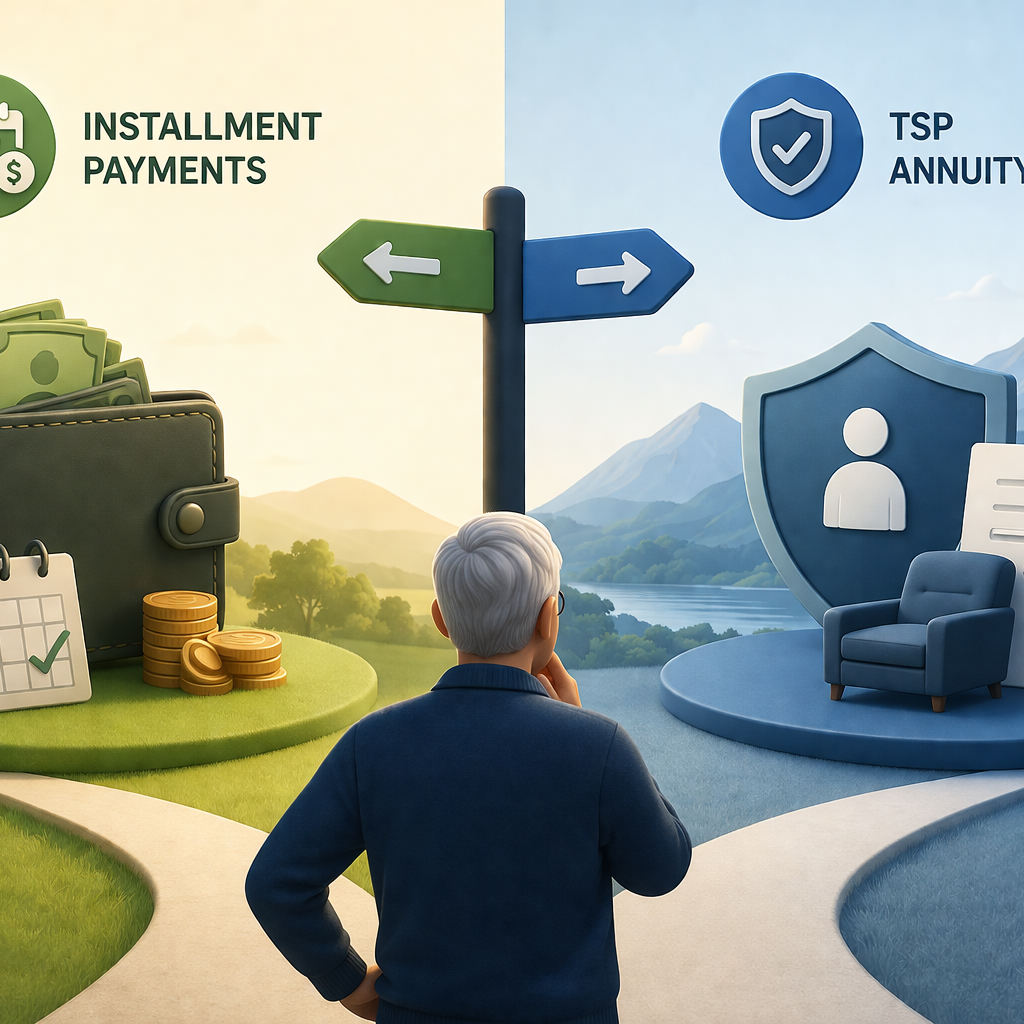
- Installment payments offer flexibility, while TSP annuities provide guaranteed income for life.
- The optimal retirement payout choice depends on your need for control, stability, and legacy planning.
If you’re nearing retirement from federal service, deciding how to turn your Thrift Savings Plan (TSP) into income is a big step. Two of the most common strategies—installment payments and TSP annuities—offer distinct approaches. Understanding their mechanics, trade-offs, and suitability helps ensure your retirement plan fits your goals.
What Are Installment Payments?
Definition and Basics
Installment payments from your TSP allow you to receive a scheduled series of withdrawals
- Also Read: Phased Retirement Program: Key Steps, Pension Impact, and Eligibility Rules
- Also Read: Survivor Benefits Comparison: Federal, USPS, and Military Eligibility Rules
- Also Read: Case Study: TSP Loans—Eligibility, Repayment, and Retirement Impact Explained
Typical Withdrawal Options
You have several choices in how installments are paid out. These include setting a specific monthly, quarterly, or annual dollar amount, or choosing to have payments based on your life expectancy. The TSP lets you adjust your installment amounts in future years, giving you flexibility as your financial circumstances or retirement goals change.
Who Might Consider This Approach?
Installment payments are often appealing if you desire ongoing flexibility and control over your money. If you anticipate expenses that might fluctuate, want to adapt your strategy over time, or prefer to keep funds accessible for legacy or unforeseen needs, installment payments may offer the control you want.
What Is a TSP Annuity?
How TSP Annuities Work
A TSP annuity involves converting some or all of your TSP balance into a contract with a third-party annuity provider. In exchange, you receive a fixed or variable stream of income for life (or for another defined period), based on terms you choose when setting up the annuity. After your selection, you give up ownership of the converted TSP funds in exchange for the promise of regular, reliable payments.
Types of Payout Structures
TSP annuities can be tailored in several ways. Options may include single life (income for your lifetime), joint life (covering your life and a spouse’s), or specific term periods. You might also be able to add features that protect against inflation or provide for beneficiaries, though these typically affect the payment amount.
Eligibility Requirements
To purchase a TSP annuity, you must be eligible for TSP withdrawals—generally after separating from federal service. Minimum and maximum purchase amounts may apply, and you’ll need to select among available benefit options at the time of purchase. Once the annuity contract is issued, your choices become irreversible.
How Do They Differ?
Payout Flexibility Compared
Installment payments let you set, pause, or modify your withdrawal amounts—offering a high level of flexibility. In contrast, once you purchase a TSP annuity, your payments are fixed under the terms of the contract; changes are not permitted after the annuity has been issued.
Long-Term Income Stability
Annuities are designed to offer stable, predictable income for life (or for a set period). This can be comforting for those prioritizing longevity protection. Installment payments depend on your account balance and withdrawal rate: if you withdraw rapidly or market conditions reduce your TSP balance, funds could eventually run out.
Optional Beneficiaries
With installment payments, your TSP account remains yours, and any unused balance can be designated to a beneficiary upon death. In most annuity structures, residual TSP funds are no longer accessible once converted. Some annuity options allow you to provide for survivors, but this must be established up front and may reduce your monthly payment amount.
What Are the Pros and Cons?
Advantages of Installment Payments
- Flexibility: Adjust payment amounts as your situation changes, or stop/restart withdrawals as needed.
- Control: Maintain access to and ownership of your remaining TSP balance for emergencies, opportunities, or legacy purposes.
- Beneficiary Friendly: Any unused balance can pass directly to designated heirs or beneficiaries.
Advantages of TSP Annuities
- Predictable Lifetime Income: Receive a steady, reliable stream of income for life, regardless of market changes.
- Longevity Protection: No risk of ‘outliving’ your payments; income is sustained as long as you (or you and your joint annuitant) live.
- Simplicity: Minimal ongoing decisions or management required after the annuity is set up.
Potential Drawbacks for Each Option
- Installment Payments: Payments end when your account is exhausted, so there’s a risk your funds may run out if withdrawals are too high or markets decline.
- TSP Annuity: Loss of flexibility and control over the converted funds; decisions are permanent and may limit opportunity for beneficiary inheritance unless special features are chosen.
Which Suits Different Retirement Needs?
Considering Personal Financial Goals
Think through your personal retirement objectives and risk tolerance. If you value flexibility, control, and access to your savings, installment payments may align with your goals. If guaranteed, lifelong income and simplicity are your priorities, TSP annuities provide that peace of mind.
Lifestyle and Legacy Considerations
Consider your lifestyle: Will your expenses be steady or fluctuate? Do you hope to leave unused funds for loved ones, or is maximizing your own lifetime income more important? Those with complex family needs or legacy goals may favor installment payments, while annuities are best for those who seek certainty and are less concerned with bequests.
Can You Change Strategies Later?
Flexibility After Initial Choice
Installment payment plans generally allow you to change the amount or schedule of withdrawals, and you can even switch to a full withdrawal or purchase an annuity later. However, if you select a TSP annuity, the decision is permanent; existing funds used for the annuity cannot be reclaimed or reassigned to installment payouts.
Important Timing Considerations
Carefully time your choice, considering both your retirement date and personal financial horizon. Once an annuity is issued, it cannot be reversed. Installment payments let you adjust as your needs evolve, so waiting to buy an annuity (if ever) can keep your options more open.