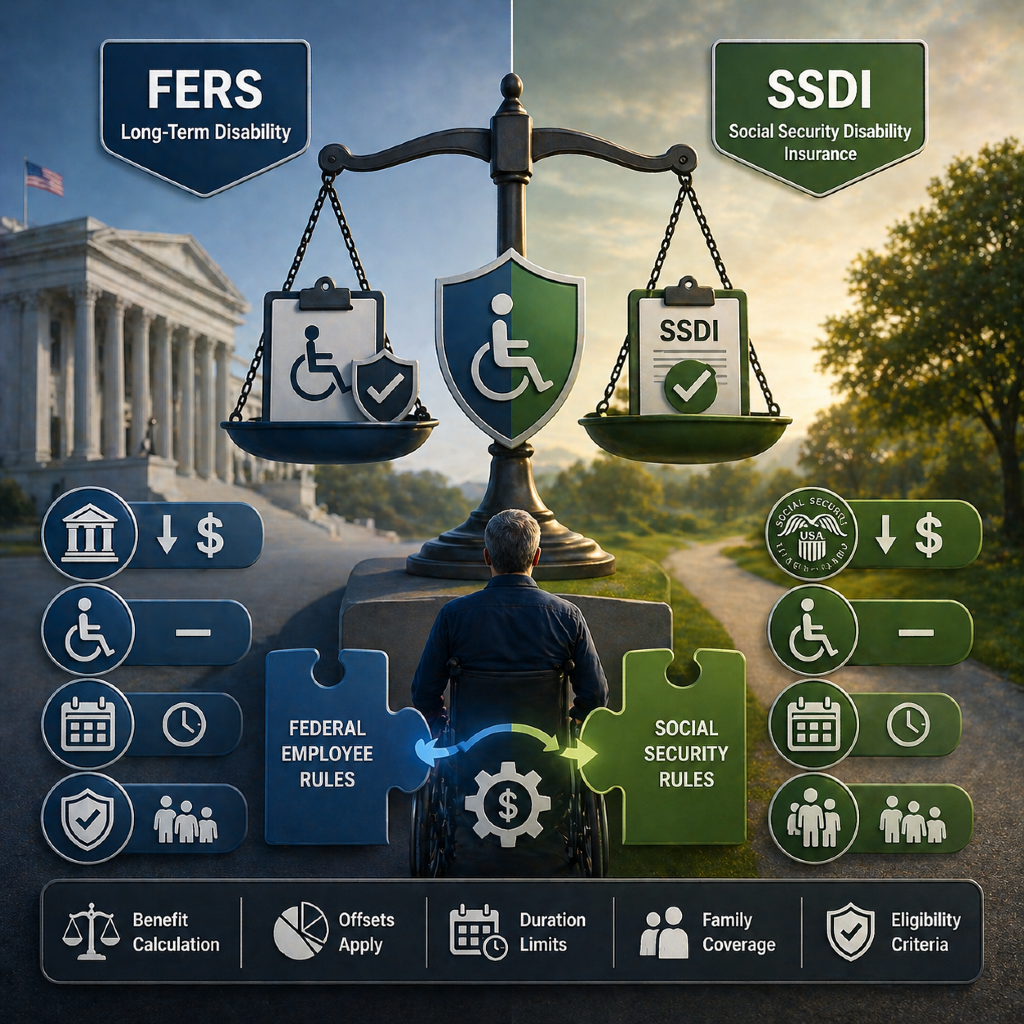

Key Takeaways
- Understand how FERS and SSDI differ in eligibility, benefits, and integration for disabled federal employees.
- Offsets can significantly impact payments when coordinating multiple disability benefit programs.
Navigating disability benefits as a federal employee can be complex, especially when considering long-term disability (LTD), Federal Employees Retirement System (FERS) disability retirement, and Social Security Disability Insurance (SSDI). Learning how eligibility, benefit integration, and offsets work puts you in control of your financial security during unexpected health events.
What Is Long-Term Disability Insurance?
- Also Read: Phased Retirement Program: Key Steps, Pension Impact, and Eligibility Rules
- Also Read: Survivor Benefits Comparison: Federal, USPS, and Military Eligibility Rules
- Also Read: Case Study: TSP Loans—Eligibility, Repayment, and Retirement Impact Explained
Typical coverage scope
LTD insurance typically covers a portion of your salary if you experience a qualifying disability. Coverage periods can range from a couple of years up to retirement age, depending on the policy design. Some plans may include rehabilitation support or partial disability provisions, helping you return gradually to work when medically possible.
Eligibility for benefits
Most LTD policies require you to meet specific employment standards, such as being a full-time federal employee and working for a set period before becoming eligible—often a year or more. You usually must demonstrate, through medical evidence, that your condition prevents you from performing the substantial duties of your own occupation (or, in some cases, any occupation as defined by the plan).
Common filing process
Filing a LTD claim generally starts by notifying your employer and the insurance carrier promptly after your disability. You’ll need to provide detailed medical records and regular updates on your status. The insurer reviews the evidence and decides whether to approve or deny the claim. In some cases, you may need to cooperate with rehabilitation programs or periodic status reviews to continue receiving benefits.
How Does FERS Disability Retirement Work?
The Federal Employees Retirement System (FERS) offers a disability retirement benefit to federal workers who can no longer perform their job due to a medical condition and meet federal standards.
FERS eligibility criteria explained
To qualify, you must have completed at least 18 months of creditable federal civilian service. Your disabling medical condition must be expected to last at least a year and make you unable to perform your job duties. Importantly, your agency must certify it cannot accommodate your condition or reassign you to a suitable position within the organization.
Benefit calculation basics
FERS disability annuity amounts depend on your years of service, high-three average salary, and age at disability. Unlike private long-term disability insurance, you may also receive adjustments if you’re under 62 or become eligible for regular retirement. The amount integrates, in part, with projected Social Security disability benefits for younger applicants but shifts over time as you age.
Integration with other benefits
FERS disability is coordinated with other government benefits such as SSDI. If approved for SSDI, the FERS benefit is reduced (or “offset”) to account for those additional payments. This prevents duplicate replacement of income, ensuring combined benefits don’t exceed pre-disability earnings.
What Is SSDI and Who Qualifies?
Social Security Disability Insurance (SSDI) is a federal program managed by the Social Security Administration. It provides partial income replacement to people who are unable to work because of significant long-term disabilities.
SSDI qualification steps
First, you must have worked and paid Social Security taxes for the required number of quarters, usually through recent and sufficient employment history. Next, you complete an application providing comprehensive medical documentation about your disabling condition.
Medical requirements overview
SSDI’s medical standards are strict. Your condition must be severe enough to prevent you from performing any substantial gainful activity, not just your previous job. The disability must be expected to last at least 12 months or result in death. The evaluation considers your diagnosis, symptoms, treatment history, and objective test results.
Work history considerations
To qualify, you typically need a history of Social Security-covered employment (not just federal service). The number of years required varies with your age, but even federal workers must show recent contributions to the Social Security system to be eligible for SSDI.
Offsets: What Are They and Why Do They Matter?
Understanding “offsets” is key if you’re eligible for more than one disability benefit at once.
Definition of offsets
Offsets are reductions applied to one benefit when another similar benefit is paid. They prevent a person from receiving duplicate income replacement for the same period they’re unable to work.
How offsets impact payments
When you qualify for both FERS disability and SSDI, your FERS payment is reduced to account for some or all of your SSDI award. Similarly, some private LTD policies include provisions that offset your LTD payments by the monthly amount received from SSDI or similar sources.
Coordinating multiple benefits
Coordinating benefits ensures no “double-dipping” and aligns total disability income with pre-disability earnings. For federal employees, this means careful navigation between FERS, SSDI, and potential LTD coverage. It’s important to monitor notifications from each agency and communicate promptly about changes to avoid overpayments or underreported benefits.
Key Differences Between FERS and SSDI
Federal employees and retirees need a clear picture of how these programs differ before applying.
Eligibility comparisons
- FERS: Requires at least 18 months of federal service and a disabling condition preventing your federal job performance.
- SSDI: Focuses on broader Social Security-covered work history and an inability to do any substantial work, not just your federal role.
Benefit structure distinctions
FERS provides a disability annuity based on service time and salary, with offsets for other benefits like SSDI. SSDI determines payments from your Social Security earnings record, independent of federal service calculations, and continues until recovery, retirement age, or death.
Application timelines
FERS and SSDI each involve lengthy, multistep application processes. FERS typically requires more immediate agency action; SSDI approval timelines can vary widely, sometimes lasting months or longer. Documentation is essential for both, but each evaluates your eligibility under different rules and medical standards.
Pros and Cons of Each Benefit Type
Comparing the advantages and drawbacks helps you make informed decisions.
Advantages of FERS disability
- Tailored for federal employees with unique positions and job requirements
- May coordinate with federal retirement and survivor benefits
- Offers continued federal service credit for certain benefits calculations
Drawbacks of FERS disability
- Application process can be complex and require detailed employer involvement
- Offset rules with SSDI may reduce overall FERS disability payment
Advantages and drawbacks of SSDI
- Nationwide safety net independent of federal employment status
- Strict qualification rules and lengthy determination times
- Payments are not tied to your specific federal service but to Social Security contributions
Which Program Fits Your Situation?
Choosing between FERS, SSDI, or using both requires self-assessment and access to trusted resources.
Factors influencing your choice
Consider the severity of your medical condition, the length and type of your federal service, and whether your employment was continuously covered by Social Security. Review your LTD policy and check how offsets may adjust any potential disability income.
Consulting knowledgeable resources
Federal human resources professionals, retirement counselors, and knowledgeable legal professionals specializing in disability retirement can provide valuable guidance. Their experience interpreting the latest post-2025 changes to benefits coordination and offsets ensures you don’t face surprises after approval.
Next educational steps
Stay informed on annual updates from OPM, Social Security, and your LTD provider. Educational workshops, published guides, and federal benefit webinars are helpful for deepening your understanding and building confidence as you approach or navigate retirement.